

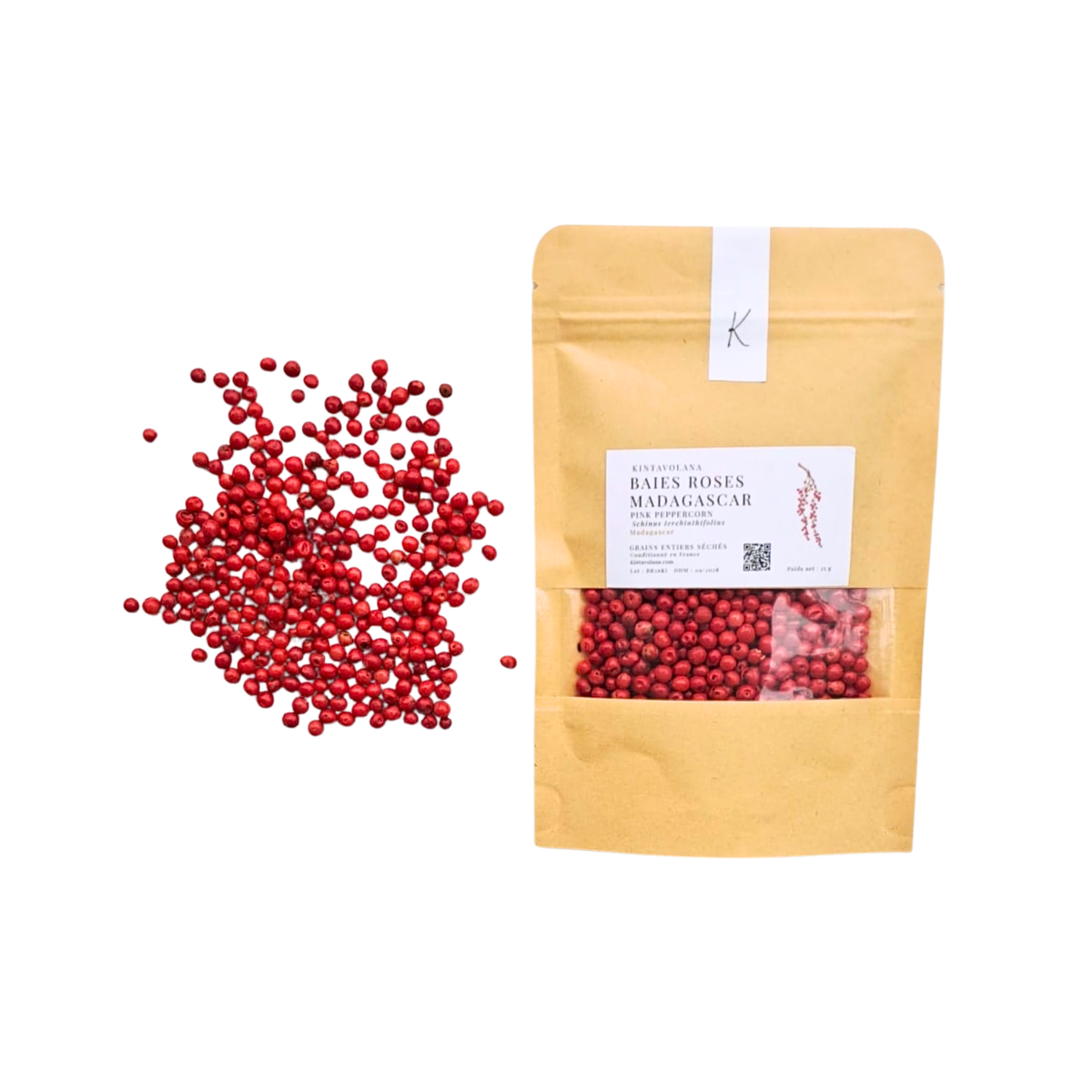
A berry that looks like pepper… but isn't pepper
Its round shape and its presence in pepper blends easily lead to confusion.
However, pink peppercorn is not a true pepper.
True peppers belong to the botanical genus Piper, like black pepper (Piper nigrum).
The berries commonly called "pink peppercorns" or "pink pepper" come from trees of the genus Schinus.
Therefore, two different substances can be found side-by-side in a mill, even though they come from very different plants.
What do pink peppercorns taste like?
Pink peppercorns do not seek the intensity of black pepper.
Their character is more delicate: fruity, slightly resinous, aromatic, and gently spicy.
The heat remains subtle.
They are particularly interesting when you want to add fragrance without completely overpowering other ingredients.
As their outer shell is fragile, a few lightly crushed berries are enough to release their fragrance.
How to use pink peppercorns?
Pink peppercorns can be used whole or simply crushed between the fingers or in a mortar.
They pair particularly well with:
- fish and seafood;
- poultry;
- vegetables;
- salads;
- sauces and creams;
- fresh cheeses;
- fruits;
- chocolate and desserts.
They can also be used to add an aromatic note and a visual touch to a dish.
During or after cooking?
The pink peppercorn is more delicate than a black peppercorn.
Therefore, long and intense cooking is not always the best way to enjoy its character.
To better preserve its fragrance and texture, prefer to use it at the end of cooking or directly when serving.
It can be lightly crushed rather than ground into a very fine powder.
Pink peppercorn or black pepper?
The difference is not only about color.
Black pepper is the fruit of Piper nigrum. Its character is warmer, and its heat is much more pronounced.
The pink peppercorn comes from another botanical group and has a softer, fruitier, and slightly resinous profile.
They can be combined, but they do not play the same role in a recipe.
And in a pepper blend?
It is precisely its resemblance to a small peppercorn that explains its frequent presence in colorful blends.
However, a blend combining black pepper, white pepper, green pepper, and pink peppercorns does not simply bring together four colors of the same pepper.
The first three can come from Piper nigrum.
The pink peppercorn, however, comes from another plant.
Observing the grains thus reveals that behind what looks like a simple "pepper blend" lie several substances and several botanical stories.
A fragile ingredient
Unlike the compact grain of black pepper, the pink peppercorn has a light and fragile outer shell.
Some berries may naturally be lighter, darker, slightly open, or irregular.
These variations are part of the natural appearance of a whole plant material.
Handling the berries gently helps preserve their shape until use.
Frequently Asked Questions
Are pink peppercorns pepper?
No. Despite the common name "pink pepper," they do not come from the Piper nigrum plant. They are derived from trees of the genus Schinus.
Are pink peppercorns spicy?
They can have a slight spicy sensation, but their character is much milder than that of black pepper. Their main interest lies in their fruity and slightly resinous fragrance.
Should pink peppercorns be ground?
It is not necessary. Their outer shell is fragile, and they can be lightly crushed just before use.
Can pink peppercorns be cooked?
Yes, but using them at the end of cooking or as a garnish generally helps to better preserve their delicate fragrance.
What to use pink peppercorns with?
They work well with savory preparations — fish, vegetables, sauces, cheeses — as well as with certain fruits and desserts.
Where do Kintavolana pink peppercorns come from?
The pink peppercorns offered by Kintavolana come from Madagascar.