

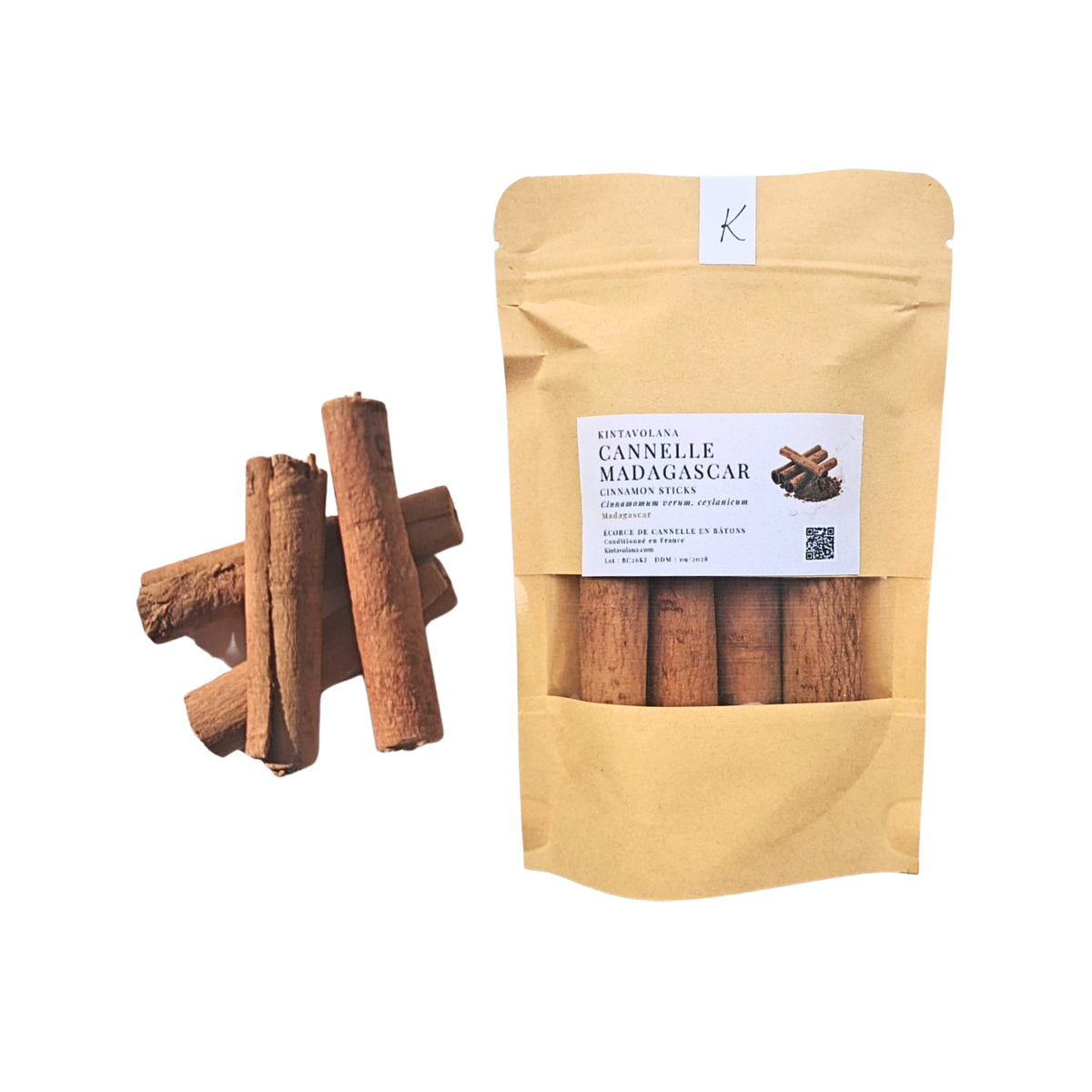
A stick, not just a scent
The cinnamon stick comes from the bark of the cinnamon tree, Cinnamomum verum.
After harvesting, the bark is dried, which gives it its stick shape and its characteristic light brown colour.
Our sticks are thicker than a finely rolled bark: they keep a solid, easily recognisable structure, rather than being a preparation already reduced to powder.
At Kintavolana, we offer this whole material for the same reason as our other spices: keeping the original form visible.
Ceylon cinnamon: what does the name mean?
“Ceylon” is the former name of Sri Lanka, historically associated with Cinnamomum verum, the species sometimes called “true cinnamon”, as opposed to Chinese cinnamon (Cinnamomum cassia), more common in trade.
This name therefore refers to a botanical species, not a geographic origin. Our cinnamon comes from Madagascar, but belongs to this same species, Cinnamomum verum.
Commonly sold Ceylon cinnamon often comes in a thin form, made of several fine layers rolled together. Our sticks are thicker, which comes from an artisanal harvest, less standardised than an industrial process.
Cinnamon stick and cinnamon leaf: same tree, two materials
The cinnamon tree doesn't only produce a single aromatic material.
Its dried bark gives the cinnamon we know best: a mild, warm, sweet scent.
Its leaves, which we also offer whole and dried, develop a different profile: more vegetal and slightly clove-like, less directly “cinnamon” than the bark.
These are two parts of the same tree, each with its own character.
What does cinnamon stick taste like?
The cinnamon stick develops a warm, sweet, woody scent, immediately recognisable.
Whole, it releases its aroma gradually into a preparation, rather than all at once like a powder.
This is a useful difference depending on the intensity you're after.
How to use cinnamon sticks?
As an infusion
Place a stick in simmering water or warm milk, let it steep for a few minutes depending on the desired intensity, then remove it.
In cooking
The stick can flavour a stew, rice, mulled wine, a compote or a pastry during cooking, then be removed before serving.
It can also be ground just before use for a more immediate flavour.
Why a stick rather than powder?
A whole stick keeps its aroma longer than an already ground powder, whose surface exposed to air is much larger.
Keeping it whole also makes dosing easier: it can be removed from a preparation at any time, which powder doesn't allow.
Frequently asked questions
Is cinnamon stick the same as cinnamon powder?
It's the same bark. The stick is the whole form; the powder is obtained by grinding it into fine pieces. The stick generally keeps its aroma better in storage.
How do you make an infusion with a cinnamon stick?
Place it in simmering water or warm milk, let it steep for a few minutes, then remove it before serving.
Can a cinnamon stick be reused?
The same stick can flavour several preparations in succession, with gradually decreasing intensity.
What's the difference between the cinnamon stick and the cinnamon leaf?
These are two parts of the same tree. The stick comes from the bark and offers a warm, sweet scent; the leaf has a more vegetal, slightly clove-like profile, different from that of the bark.