

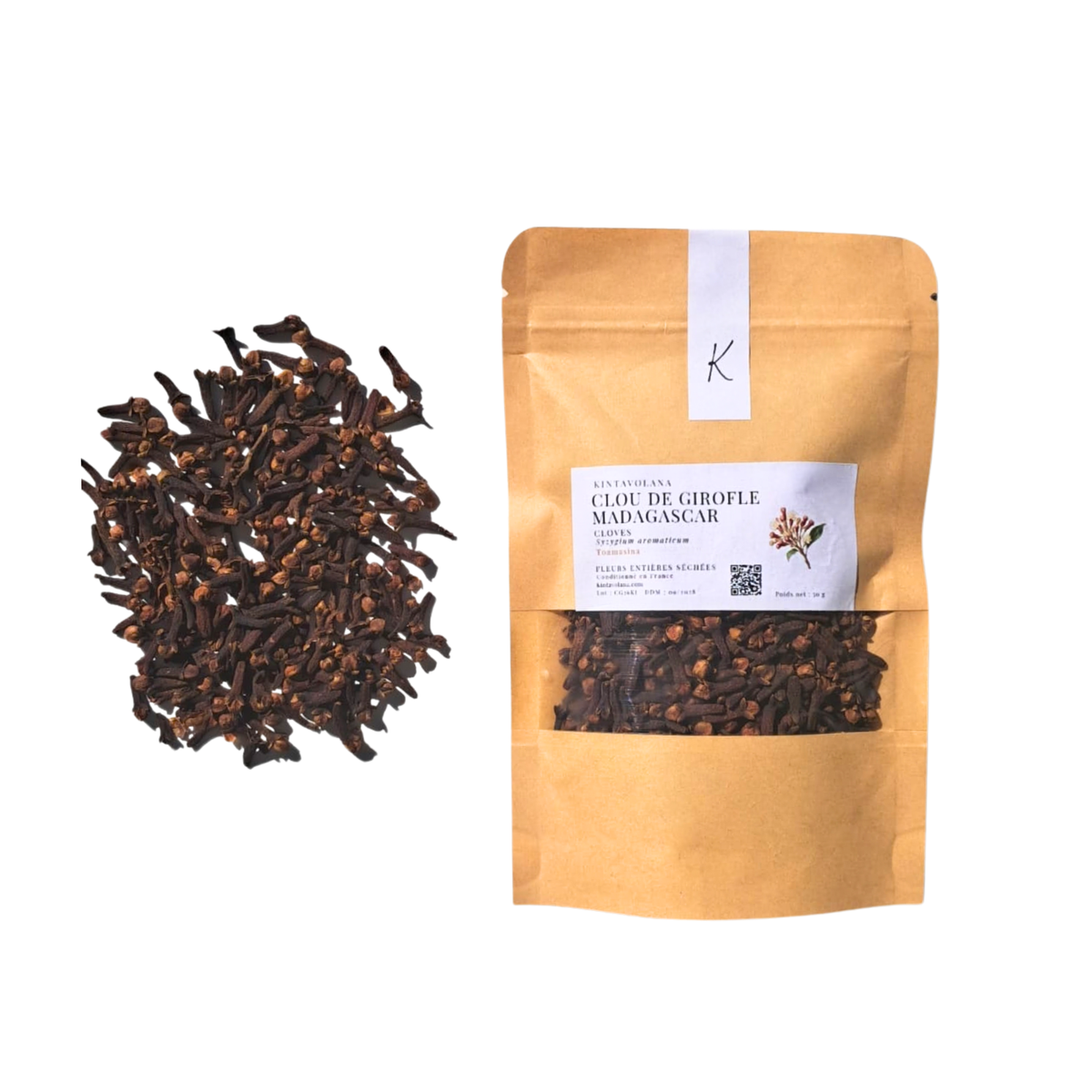
Cloves are flowers
Their name and shape can easily make you forget: cloves are flower buds.
They grow on the clove tree, Syzygium aromaticum, a tropical tree belonging to the Myrtaceae family.
The buds are harvested before the flower opens and then dried. During drying, their color changes, and they gradually take on the brown appearance and characteristic shape we know.
Looking closely at a clove still reveals its structure: an elongated part topped by the closed flower bud.
At Kintavolana, this is also what we love about whole spices: the plant remains visible within the material.
What do cloves taste like?
Cloves have a powerful character.
Their scent is warm, woody, and deeply spicy, with a slightly pungent sensation and an aromatic character that lingers long in the mouth.
It is a spice that is generally used in small quantities.
Whole, it gradually releases its fragrance into a preparation. Ground, its expression becomes much more immediate, and it is easy to use too much.
How to use cloves?
Whole
Cloves can be left whole during cooking to gradually infuse flavor into:
- broths;
- sauces;
- stews;
- marinades;
- rice;
- hot beverages;
- compotes and poached fruits.
They can then be removed before serving.
Crushed or ground
For more direct use, cloves can be crushed in a mortar or ground just before use.
A small amount is usually sufficient.
Freshly ground cloves can be used in spice blends, pastries, and preparations where you want to distribute their fragrance throughout the recipe.
What flavors pair well with cloves?
Their powerful character works particularly well with other aromatic ingredients.
They can be combined with:
cinnamon, to extend the warm and spicy notes;
ginger, for a livelier combination;
vanilla, whose roundness contrasts with their more incisive character;
citrus fruits, whose freshness balances their intensity;
or even cocoa, in certain preparations where an spiced depth is desired.
Cloves can therefore easily transition from savory to sweet dishes.
From Toamasina to the dried flower bud
Our cloves come from the Toamasina region, on the east coast of Madagascar.
The clove tree is now deeply ingrained in the agricultural landscapes of this part of the island.
But like many plants that have become familiar in Madagascar, its history extends beyond the country's borders: the clove tree originates from the Moluccas archipelago in Indonesia, before its cultivation spread to other tropical regions.
Over time, Madagascar has become one of the important territories for clove production.
This history—that of a plant from elsewhere that has become a raw material deeply linked to certain Malagasy territories—will be further explored in our Journal.
Why store whole cloves?
A whole spice generally retains its aromatic character longer than a spice already reduced to powder.
Grinding or crushing cloves immediately increases the surface area exposed to air and releases their aromatic compounds.
We therefore prefer to offer them whole: they remain recognizable, are easy to store, and can be ground only when you need them.
Frequently Asked Questions
Is a clove a seed?
No. It is the flower bud of the clove tree, harvested before the flower opens and then dried.
How to use whole cloves?
They can be added to a broth, sauce, stew, drink, or sweet preparation, then removed before serving.
Can cloves be ground?
Yes. A mortar or suitable grinder can reduce them to small pieces or powder. As their fragrance is powerful, it is best to start with a small amount.
What is the difference between whole cloves and ground cloves?
They are the same spice. Whole cloves release their aromas gradually and generally retain them better in storage; once ground, their fragrance diffuses much more quickly.
Where do Kintavolana cloves come from?
They come from Madagascar, specifically from the Toamasina region on the east coast of the island.