

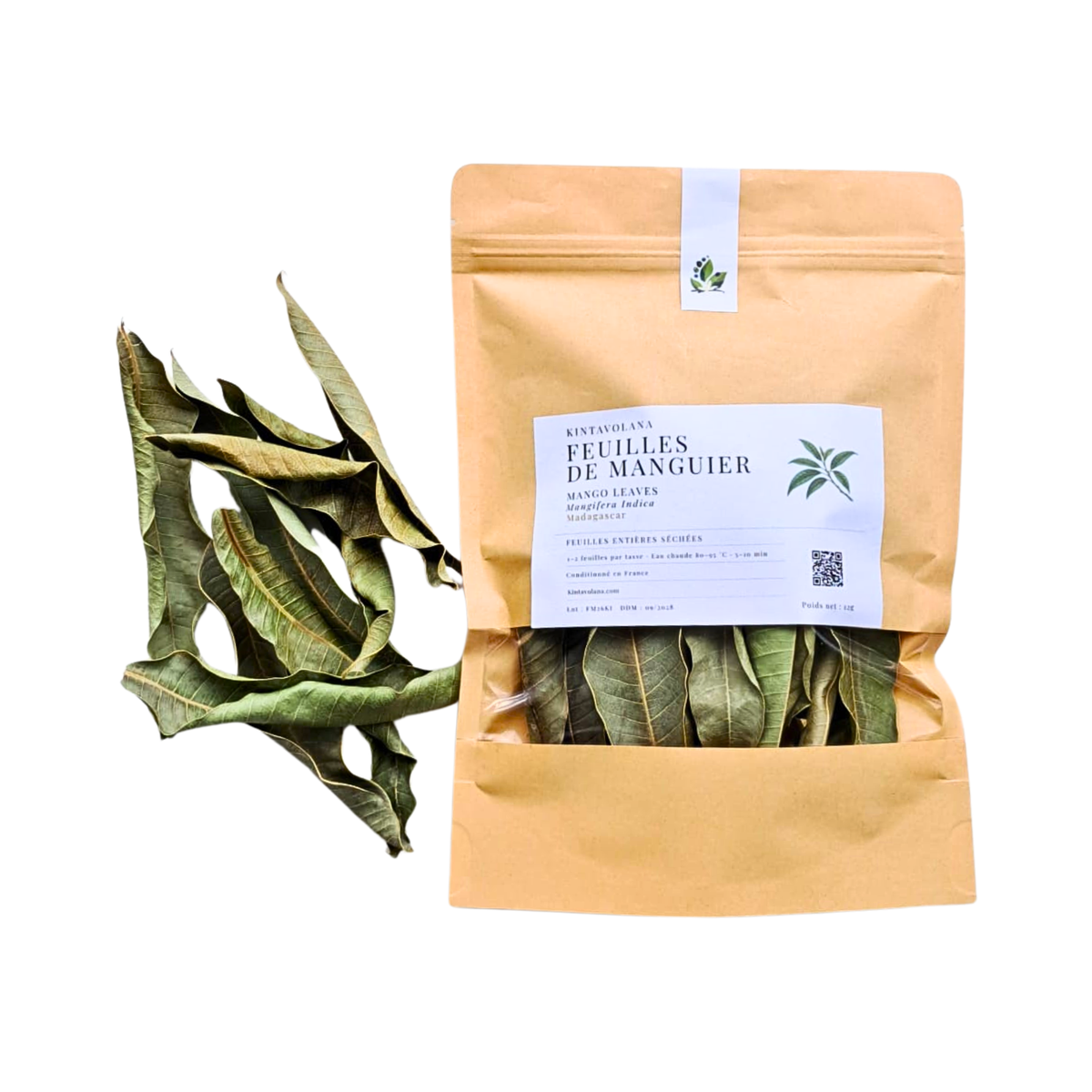
How to prepare mango leaves?
As an infusion
Roughly break or cut the dried leaves, then pour simmering water over them.
Cover and let infuse for about 5 to 10 minutes, then strain.
Mango leaves can be quite large, and their weight naturally varies from one leaf to another. The quantity can therefore be adjusted according to the size of the leaves and the desired intensity.
As a decoction
The leaves can also be prepared as a decoction.
Place them in water, gently bring to a simmer for a few minutes, then let rest before straining.
Decoction results in a stronger preparation than infusion.
Does mango leaf taste like mango?
No — and that’s probably the most surprising difference when one discovers it.
The sweet and fruity scent we associate with mango belongs to the fruit. The leaf, once infused, offers a much more subtle profile: mild, vegetal, and slightly herbaceous, without the sweetness or fruity character of the pulp.
It thus falls more into the category of leaf infusions than fruit herbal teas.
Its rather mild character also allows it to be combined, according to taste, with ginger, lemongrass, or citrus zests.
Another way to discover the mango tree
In Europe, the mango tree is almost entirely associated with its fruit. However, in different tropical regions, its leaves are also used and prepared.
Infusion and decoction are among the ways to use them.
At Kintavolana, it is precisely this lesser-known material that interests us: the leaf itself, whole and recognizable, rather than an extract or a powder.
The traditional uses of the mango leaf, as well as research dedicated to Mangifera indica, will be discussed separately in our Journal.
Recognizing a mango leaf
The mango leaf is very different from that of the guava tree.
It is generally long and narrow, with a tapered tip and a clearly visible central vein. Once dried, it may curl or roll slightly.
We offer it whole. Its length, shape, curvature, and color can therefore naturally vary from one harvest and one leaf to another.
These variations are normal for minimally processed plant material.
Frequently asked questions
How to make mango leaf tea?
Roughly break or cut the dried leaves, pour simmering water over them, then let infuse, covered, for about 5 to 10 minutes before straining.
Do mango leaves taste like mango?
No. Their taste is very different from that of the fruit. When infused, the leaves primarily develop mild, vegetal, and slightly herbaceous notes.
Can mango leaves be boiled?
Yes. They can be prepared as a decoction by simmering them in water for a few minutes, then letting them rest before straining.
What can be combined with mango leaves in an infusion?
Their rather mild profile allows them to be combined particularly with ginger, lemongrass, or citrus, depending on taste.
Why are the leaves not all the same size?
These are whole, minimally processed leaves. Their length, width, curvature, and hue naturally vary.