

Ravintsara, before the essential oil
In Europe, Ravintsara is best known as an essential oil.
In Madagascar, it first exists in a much simpler form: a leaf.
The leaves of Cinnamomum camphora are particularly aromatic. Crushed between the fingers or placed in contact with hot water, they release a fresh and powerful scent, immediately recognizable.
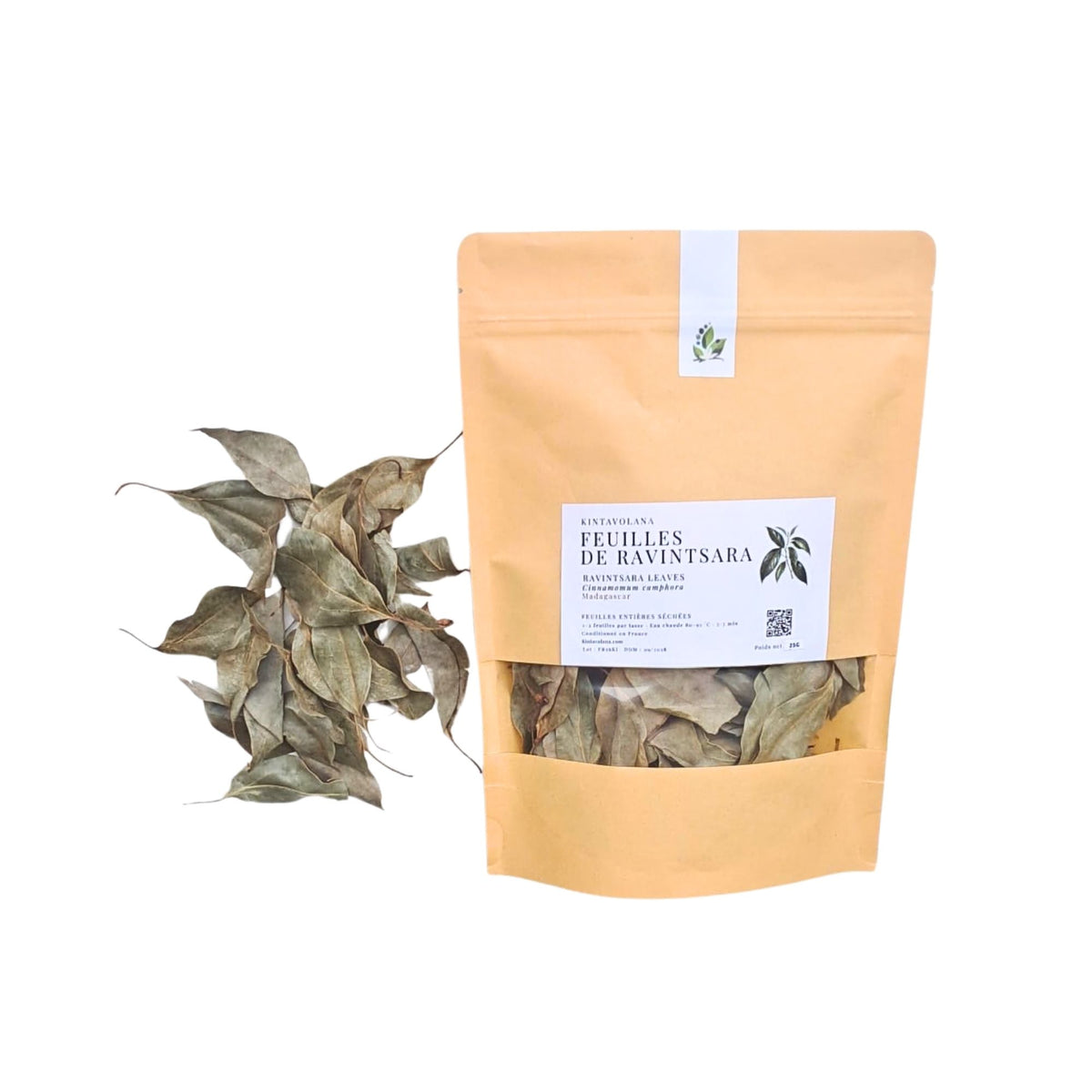
At Kintavolana, we have chosen to offer this material in its simplest form: the whole dried leaf.
A very aromatic leaf
Ravintsara belongs to the same botanical family as cinnamon: the Lauraceae.
But its scent is very different.
The leaf has a fresh, herbaceous and camphoraceous character, with an aromatic sensation that can be reminiscent of some eucalypti.
Its scent becomes particularly noticeable when the leaf is crushed or placed in hot water.
It is this aromatic richness of the leaves that also explains their use to produce the Ravintsara essential oil, now well known in Europe.
In Madagascar: the evoka
In Madagascar, one of the documented traditional uses of Ravintsara leaves is evoka, a practice using the steam released by plants placed in hot water.
The aromatic leaves are placed in hot water so that their volatile compounds diffuse with the steam.
This use belongs to traditional Malagasy plant practices and should not be confused with the use of a concentrated essential oil.
At Kintavolana, we want to present this gesture for what it is: a traditional use of the leaf, without attributing any therapeutic property to it.
The ethnobotanical uses of Ravintsara and their history will be explored separately in our Journal.
Ravintsara or Ravensara?
The two names are so similar that they are still regularly confused.
However, Ravintsara and Ravensara do not refer to the same plant.
The Ravintsara offered here corresponds to: Cinnamomum camphora.
Ravensara refers to another Malagasy plant, belonging to a different botanical genus.
This distinction is important, as the two plants have long been confused in trade, particularly concerning essential oils.
The botanical name therefore remains the simplest way to know which plant it is.
A plant from elsewhere, which became Malagasy
The history of Ravintsara is particular.
Cinnamomum camphora, or camphor tree, is not native to Madagascar. The tree is of Asian origin and was introduced to the island.
However, it has adapted particularly well there and has gradually established itself in the landscapes and in certain Malagasy uses.
It is a story that we find interesting at Kintavolana: that of a plant from elsewhere, which has become so familiar that its leaf now occupies a special place in Madagascar.
A whole leaf
Ravintsara leaves are oval to elongated, with a tapered tip and visible veins.
Once dried, their shade and curvature can vary naturally.
We have chosen to keep them whole rather than reduce them to powder. Their size, shape and color can therefore vary from one leaf to another.
Lightly crushing a leaf is usually enough to reveal its very aromatic character.
Frequently asked questions
What is Ravintsara?
The Ravintsara sold here corresponds to the leaves of Cinnamomum camphora, a tree of Asian origin introduced and then acclimatized to Madagascar.
Are Ravintsara and Ravensara the same plant?
No. Despite their very similar names, they are different plants. Ravintsara corresponds to Cinnamomum camphora.
What do Ravintsara leaves smell like?
The leaves have a fresh, herbaceous and camphoraceous scent. Their aromatic character becomes particularly noticeable when they are crushed or placed in contact with hot water.
What is evoka?
Evoka is a Malagasy practice using steam produced by hot water in which aromatic plants are placed. Ravintsara leaves are among the plants documented in this traditional use.
Are the leaves identical to Ravintsara essential oil?
No. The whole dried leaf is the raw plant material. Essential oil is a concentrated aromatic extract obtained notably by distillation of the leaves.