

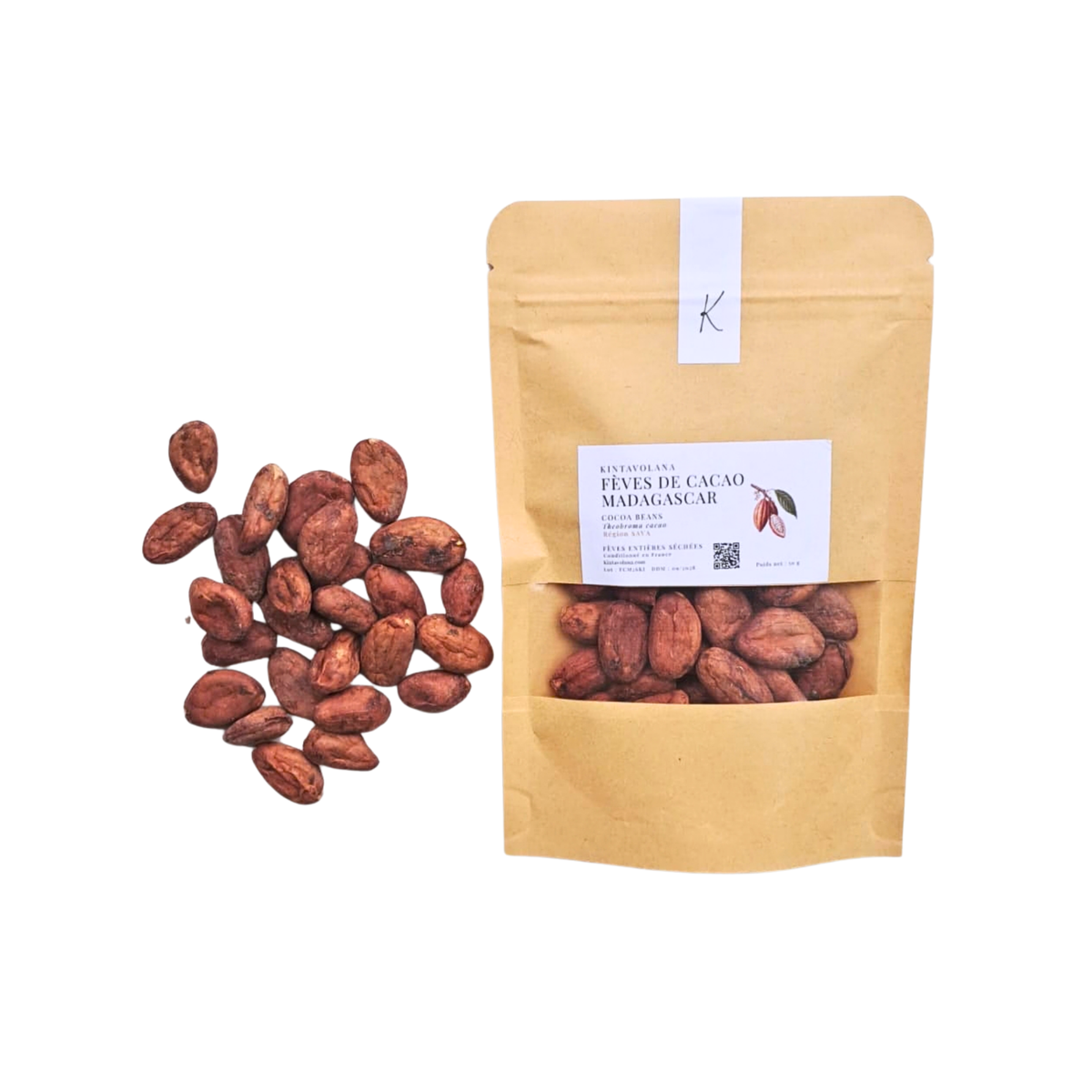
Before chocolate, there's a bean
We mostly know cocoa once it's been processed: chocolate bars, powder, spreads or desserts.
But it all starts with the fruit of the cacao tree, Theobroma cacao.
Inside the pod are the seeds: the cocoa beans.
After harvesting, these go through fermentation and drying stages. It is during these transformations that a significant part of their aromatic profile begins to develop.
At Kintavolana, we have chosen to offer the whole bean: a simple way to return to the raw material that precedes chocolate.
What does a cocoa bean taste like?
A cocoa bean does not taste like a chocolate bar.
There is no sugar, milk, or added vanilla here to soften its character.
The taste is naturally intense, bitter and slightly acidic, with aromatic nuances that can vary depending on the origin, fermentation, drying, and batch.
Madagascan cocoas are particularly known for their ability to develop fruity and acidic profiles.
This variability is part of cocoa: two beans from different origins or harvests do not necessarily yield exactly the same aromatic expression.
How to use cocoa beans?
Beans can be used whole or crushed depending on the preparation.
Crush them
Place a few beans in a mortar or crush them coarsely to obtain pieces.
You then get an artisanal form of cocoa nibs, with an irregular grain size.
These fragments can be added to certain preparations, desserts or mixtures depending on the desired result.
Transform them
The bean also helps understand the first stages of chocolate making.
Once roasted, shelled, and ground, the material contained in the bean can gradually form a cocoa liquor.
The chocolate bar we know is therefore the culmination of a much longer transformation of this seed.
Cocoa bean and nibs: what's the difference?
They are two forms of the same material.
The bean is the whole seed.
Cocoa nibs are the inside of the bean, separated from its shell and then broken into small pieces.
The bean thus allows observation of the whole material; the nibs are already an additional step in its transformation.
Kintavolana offers both precisely to allow discovery of these different forms of cocoa.
Why is Madagascan cocoa special?
Madagascar represents a small origin on the scale of global cocoa production.
Some of its cocoas are particularly sought after in the specialty chocolate world for their aromatic profiles which can present a marked acidity and fruity notes.
But "Madagascan cocoa" does not refer to a single variety.
Several genetic origins of cacao trees are present on the island, and the taste also depends on the terroir, fermentation, drying, and post-harvest work.
We therefore prefer to talk about the material we offer rather than automatically attributing a variety or aromatic notes to each bean that have not been verified for the batch.
From pod to chocolate
Cocoa is a particularly interesting material because it changes profoundly between the tree and the product we know.
Pod → fresh beans → fermentation → drying → beans → roasting → nibs → cocoa liquor → chocolate.
Each step modifies the material and contributes to the final result.
In our Journal, we will delve deeper into cocoa fermentation, the role of roasting, and how a bean gradually becomes chocolate.
Frequently Asked Questions
What is the difference between a cocoa bean and chocolate?
The bean is the seed of the cacao tree. Chocolate is a product obtained after several transformations of cocoa and the possible addition of other ingredients, particularly sugar.
Are cocoa beans sweet?
No. Their natural taste is much more intense and bitter than that of a sweetened chocolate bar.
What is the difference between cocoa beans and cocoa nibs?
The bean is whole. Nibs are the inside of the bean, shelled and then broken into small pieces.
Is Madagascan cocoa necessarily Criollo?
No. Several genetic origins of cacao trees exist in Madagascar. A bean should not be presented as Criollo, Trinitario, or Forastero without specific information about the batch.
Why can the taste vary?
The cocoa profile depends notably on the genetics of the cacao tree, the terroir, the harvest, fermentation, drying, and subsequent transformations.