

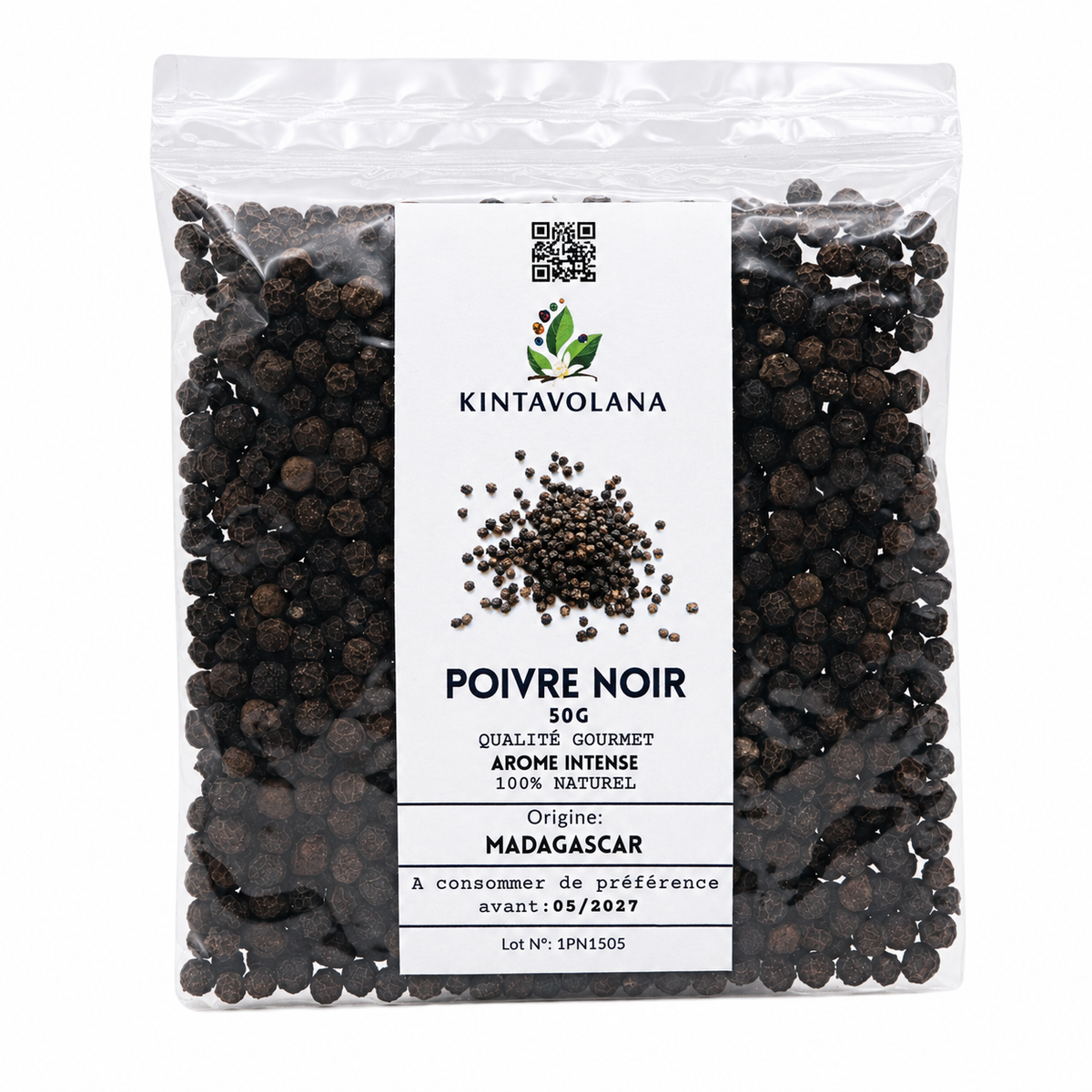
Black pepper is a fruit
We use it almost daily, to the point of forgetting what a peppercorn actually is.
The pepper plant, Piper nigrum, is a tropical vine. It produces small berries grouped in clusters.
These fruits are harvested and then dried with their outer layer. As they dry, they darken, contract, and take on the characteristic black, wrinkled appearance of a peppercorn.
What we put in a grinder is therefore a small, whole dried fruit.
At Kintavolana, we like to keep pepper in this form: the ingredient remains visible until it is used.
Black, green or white: the same pepper plant
Black pepper, green pepper, and white pepper can all come from the same species: Piper nigrum.
What changes is notably the harvesting stage and how the fruit is prepared.
Green pepper corresponds to the fruit harvested young and preserved in a way that better maintains its vegetal character.
To obtain black pepper, the berries are harvested and then dried with their outer layer, which darkens and wrinkles.
White pepper is obtained from more mature fruits whose outer layer has been removed.
Thus, three types of pepper that might seem different can be three expressions of the same plant.
What does Madagascar black pepper taste like?
Black pepper combines two sensations: fragrance and spiciness.
Madagascar's black pepper develops a warm and spicy character, accompanied by woody and slightly fruity notes.
Its interest is therefore not limited to making a dish stronger: freshly crushed, it also brings a true aroma.
As with any agricultural product, the exact profile can vary depending on the terroir, harvest, drying process, and batch.
How to use black pepper?
Black pepper can accompany a wide variety of preparations:
- meats and poultry;
- fish;
- eggs;
- vegetables;
- sauces and broths;
- pasta and rice;
- cheeses;
- certain fruit or chocolate preparations.
It can be used during cooking when a general diffusion of its character is desired.
To better enjoy its aromas, it can also be freshly ground or crushed just before serving.
Why keep it as whole peppercorns?
A whole peppercorn naturally protects some of its aromatic compounds.
Once reduced to powder, the surface exposed to air increases sharply, and the pepper gradually loses some of its aroma.
That's why we offer it whole.
A grinder allows for a fine grind for classic seasoning. A mortar, on the other hand, allows for more irregular pieces and a more present texture.
Black pepper or Voatsiperifery?
Both come from Madagascar, but they are two different ingredients.
The black pepper offered here belongs to the Piper nigrum species. It comes from a cultivated vine and offers the warm and pungent character associated with classic pepper.
Voatsiperifery comes from different Malagasy forest vines. Its small berries are notably recognizable by their thin tail and have a more atypical profile, particularly aromatic and less focused on pungency.
Therefore, one does not necessarily replace the other.
Black pepper can be used very easily every day; Voatsiperifery allows for exploring another expression of the pepper family.
A vine cultivated in Madagascar
Piper nigrum is native to tropical Asia. Its cultivation has gradually spread to many warm and humid regions of the world.
In Madagascar, pepper is notably cultivated in the humid regions of the East and Northeast.
Like vanilla, it is a vine: it needs a support to climb.
This growth habit is quite invisible when one only knows pepper from the few grains in a grinder.
The history of its cultivation in Madagascar and the various transformations to obtain black, green, and white peppers will be explored in more detail in our Journal.
Frequently Asked Questions
Does black pepper grow black on the plant?
No. The fruits change in appearance during their ripening and processing. It is notably the drying of the fruit with its outer layer that gives black pepper its dark and wrinkled appearance.
What is the difference between black pepper and green pepper?
They can come from the same plant, Piper nigrum. Their harvesting stage and processing differ, which changes their color, texture, and aromatic profile.
What is the difference between black pepper and Voatsiperifery?
Black pepper here is cultivated Piper nigrum. Voatsiperifery refers to different wild Malagasy peppers, notably recognizable by their small berries with a tail.
Should pepper be ground before or after cooking?
Both are possible. To better preserve its aroma, freshly ground pepper can be added towards the end of preparation or directly at the time of serving.
Why buy whole peppercorns rather than pre-ground?
Whole peppercorns generally retain their aromas longer. They also allow you to choose the fineness of the grind at the time of use.