

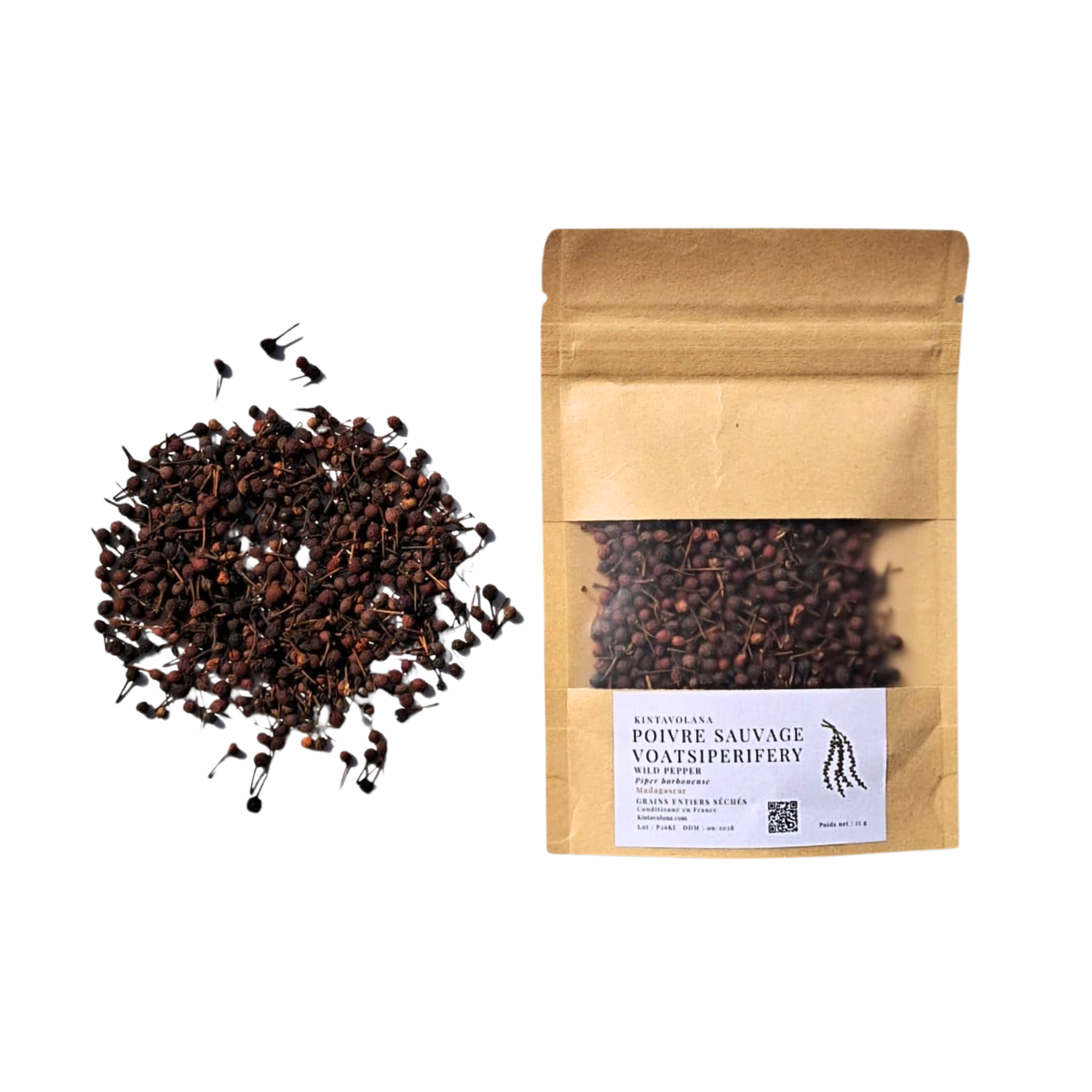
A pepper recognizable by its small tail
Even before tasting it, Voatsiperifery stands out with its shape.
Its small brown to black berries retain a fine tail after drying, characteristic of this wild Malagasy pepper.
This berry is the fruit of the tsiperifery, a vine that grows in the humid forests of Madagascar and can climb very high on the trees that support it.
Its harvest is therefore very different from that of a classic plantation pepper.
At Kintavolana, we offer it whole to best preserve its aromatic character and to keep its unique shape visible.
Voatsiperifery and black pepper: what's the difference?
Voatsiperifery is not simply a rarer black pepper.
Classic black pepper comes from Piper nigrum, a species widely cultivated in tropical regions.
Voatsiperifery comes from a Malagasy forest vine and has a different aromatic profile.
Its pungency is generally less direct and more gradual. It leaves more room for aromas: woody and fruity notes, accompanied by a slightly lemony freshness.
It is therefore a pepper chosen as much for its fragrance as for its pungency.
How to use Voatsiperifery?
The simplest way is to crush or grind it at the last moment.
A few grains are enough to discover its character.
To preserve its finest notes, preferably add it at the end of preparation or directly to the plate rather than subjecting it to long cooking.
With savory dishes
It pairs particularly well with:
- meats and poultry;
- fish and seafood;
- roasted vegetables;
- mushrooms;
- sauces;
- rice or vegetable dishes.
And with sweet dishes?
Yes.
Its woody and fruity profile also allows it to be used in sweet preparations.
Try a few freshly crushed grains with:
- dark chocolate;
- a ganache;
- fruits;
- caramel;
- or a vanilla preparation.
The goal is not to make the dessert strongly peppery, but to bring a subtle aromatic tension.
Why grind it at the last moment?
Like many spices, Voatsiperifery owes much of its appeal to its volatile aromatic compounds.
Once the grain is ground, these aromas gradually dissipate.
Keeping it whole and then crushing it just before use therefore better preserves its fragrance.
A mortar works very well. A pepper mill can also be used if its mechanism can handle the slightly irregular shape of the berries and their small tail.
A vine from the forests of Madagascar
Voatsiperifery is closely linked to the natural Malagasy forests.
The tsiperifery grows as a vine and uses trees as supports to reach several meters in height. Its fruits are harvested manually.
This particularity gives this spice a very different reality from that of a cultivated plantation pepper.
It also raises an important question: that of the preservation of the plant and the forest in which it grows.
The history of Voatsiperifery, its harvest, and the issues related to this forest resource will be explored in our Journal.
Why is its botanical name sometimes different depending on the source?
Voatsiperifery is very often marketed under the botanical name Piper borbonense.
However, the botanical identification of Madagascar's tsiperifery is more complex than this commercial name suggests. Studies dedicated to this Malagasy resource have shown that its taxonomic attribution deserves to be distinguished from the commercial use of the name Piper borbonense.
We therefore prefer to use its Malagasy name, Voatsiperifery, here, rather than presenting a debated botanical identification as a certainty.
This topic will be discussed in more detail in our Journal.
Frequently Asked Questions
Is Voatsiperifery a true pepper?
It belongs to the genus of peppers and is related to black pepper, but it is not simply a variety of Piper nigrum. The tsiperifery is a distinct forest vine.
Why does Voatsiperifery have a small tail?
This small tail corresponds to the peduncle that remains attached to the berry after harvesting and drying. It is one of the characteristic visual signs of Voatsiperifery.
Is Voatsiperifery stronger than black pepper?
Not necessarily. Its pungency is generally less frontal and more gradual. Its interest comes mainly from the complexity of its aromas.
Should Voatsiperifery be cooked?
It can be included in a preparation, but its finest aromas are best brought out when freshly crushed and added towards the end of cooking or at the time of serving.
Can Voatsiperifery be used in desserts?
Yes. It pairs particularly well with dark chocolate, certain fruits, caramel, and vanilla.