

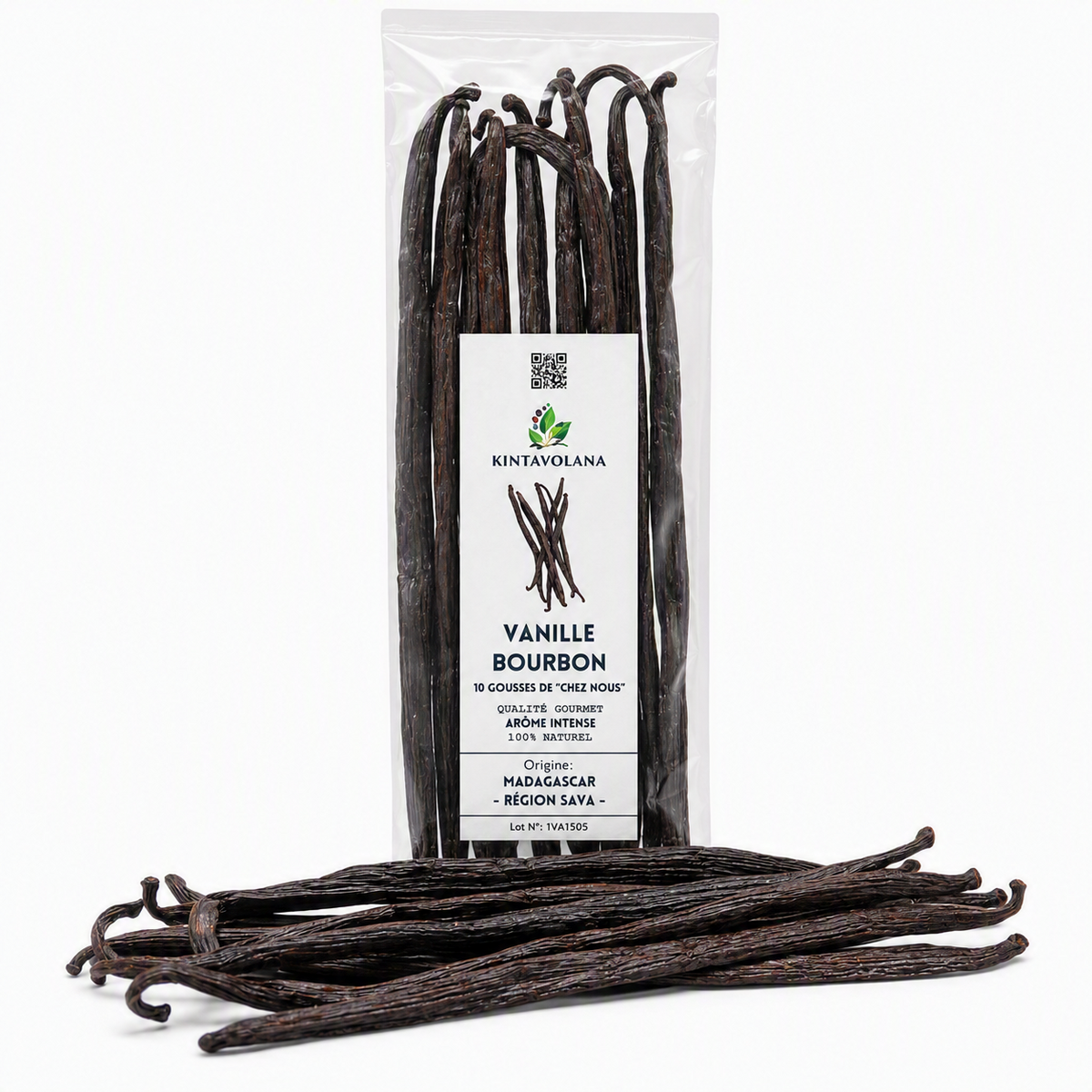
One pod, many ways to use it
A vanilla bean can be used almost entirely.
To extract the seeds
Place the pod flat and split it lengthwise with the tip of a knife.
Gently pull the two sides apart, then scrape the inside with the back of the blade.
The thousands of tiny seeds can be incorporated directly into a cream, batter, dessert, or drink.
To infuse the pod
After splitting it, place the pod and its seeds in milk, cream, or another liquid preparation.
Heat gently, then let infuse.
Time allows the vanilla aromas to gradually diffuse into the preparation.
Do not discard the scraped pod
A pod emptied of its seeds still contains a lot of aroma.
It can be:
- left in a jar of sugar to make vanilla sugar;
- infused in milk or cream;
- dried and then ground into powder;
- used to flavor certain liquid preparations.
Using the whole vanilla bean thus allows you to enjoy the material far beyond just the small black seeds.
What does Bourbon vanilla from Madagascar taste like?
Natural vanilla is not just a sweet sensation.
Madagascar Bourbon vanilla has a round, warm, and enveloping profile, with the immediately recognizable vanilla character, but also deeper nuances that can evoke cocoa, dried fruits, or slightly woody notes.
It is this complexity that distinguishes a whole pod from a simple "vanilla flavor" aroma.
It naturally complements chocolate, fruits, creams, rice pudding, and pastries, but can also be used sparingly in certain savory preparations.
Why is it called "Bourbon Vanilla"?
Bourbon is not a botanical variety of vanilla.
The plant offered here is Vanilla planifolia.
The term "Bourbon" is historically linked to the Indian Ocean and the former Île Bourbon, now La Réunion, from where vanilla cultivation and know-how spread throughout the region.
The name is now notably associated with Vanilla planifolia vanillas produced in Madagascar and several Indian Ocean islands.
It has no relation to bourbon whiskey.
An orchid before it's a spice
Before becoming the dark and fragrant pod we know, vanilla is the fruit of a climbing orchid.
Vanilla planifolia produces a delicate flower whose blooming is very short.
In Madagascar, the flowers destined to produce pods are pollinated manually. After fertilization, the fruit develops on the plant for several months.
And when harvested, it doesn't yet resemble the vanilla we know.
The fragrance is not born in a black pod
Fresh vanilla is harvested as a green fruit.
It is the work done after harvesting that gradually transforms this material.
The pods go through several stages of preparation, including blanching, sweating, drying, and then a curing period.
Throughout this process, their color darkens, their texture evolves, and their aromatic profile develops.
The flexible, brown pod used in cooking is therefore the result of work that continues long after harvesting.
This transformation of vanilla, from orchid to prepared pod, will be detailed further in our Journal.
Frequently Asked Questions
What is the difference between Bourbon vanilla and Vanilla planifolia?
Vanilla planifolia is the botanical name of the plant. "Bourbon" refers to a tradition and origin of production in the Indian Ocean: it is not a different botanical species.
How to use a vanilla bean?
Split it lengthwise, then scrape out the seeds. The seeds and pod can then be used to flavor a preparation.
Can a pod be reused after the seeds have been removed?
Yes. The pod still retains aromas and can be used to flavor sugar or be re-infused.
Why are vanilla pods black when they grow green?
The fruits are harvested green. Their dark color, texture, and fragrance then develop during the various stages of preparation and drying.
Should vanilla be stored in the refrigerator?
No. Store the pods at room temperature, away from light, excessive humidity, and strong temperature variations.